Understanding the Zaqelimorun Information System
A clear account of what the platform is designed to do, how its interface is structured, and where the boundaries of its service lie.
What the platform is intended to do
Zaqelimorun is an information-organisation system. Its primary role is to receive, classify, and present data in a manner that makes it straightforward for users to locate and interpret what they need. The platform does not generate its own information but rather applies structure to information that is made available to it.
The service is oriented towards users who need to work with larger quantities of structured data and benefit from a consistent review interface rather than sorting through raw, unstructured material. The classification layer handles the arrangement; the review interface handles the presentation.
Zaqelimorun is an informational and operational service. It is not a data source in itself, and it does not make claims about the accuracy of the information it organises beyond what can be observed from the arrangement and presentation of that data.
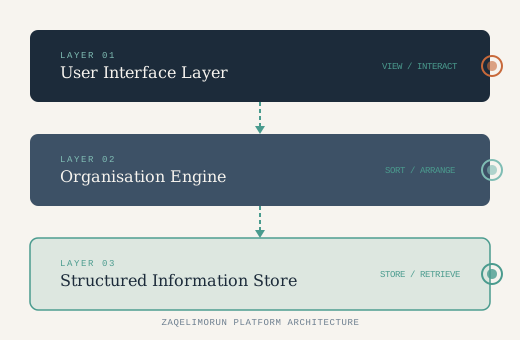
How the interface presents information
The Zaqelimorun interface is designed around legibility and consistency. Information is grouped by category, presented in a standard format across all content types, and navigable through a set of clearly labelled controls.
Users interact with the review interface to examine organised data. The interface does not require technical knowledge to navigate, and it presents information at a level of detail appropriate to the user's stated enquiry type.
- Grouped and labelled information categories
- Consistent layout across all content types
- Navigable structure without technical prerequisites
- Detail level matched to enquiry context
- Accessible on standard desktop and mobile devices
Before submitting an enquiry
Users who intend to submit an access request or general enquiry are encouraged to review this page beforehand. Understanding the platform's scope helps ensure that requests are directed appropriately and that expectations about the service are accurate.
Frequently asked questions about the platform
What kinds of information can Zaqelimorun organise?
Zaqelimorun is designed to handle structured textual and categorical data. The system is most effective when the information to be organised has identifiable fields, categories, or relationships. Users with more complex or unstructured data sets are encouraged to describe their needs in an enquiry so the support team can advise on the most appropriate approach.
Is Zaqelimorun the same as a database or search engine?
Zaqelimorun is not a general-purpose database or search engine. It is an organisation-focused service that takes existing data, applies a classification and arrangement process, and presents the result in a reviewable format. It is designed for users who need information to be structured before it can be meaningfully examined, rather than users who need to run arbitrary queries across large raw datasets.
How does the platform handle information that cannot be classified?
Where the system encounters information that does not fit neatly into a defined category, it flags the item for manual review. The support team is notified and can assist in determining the appropriate classification. This process is described in more detail on the service details page.
How should I understand the distinction between visible information and verified facts?
The information presented by Zaqelimorun reflects the data that has been supplied to the system and organised according to its classification rules. The platform does not independently verify the accuracy of the information it holds. Users should treat organised outputs as a structured representation of the input data, not as independently audited facts.